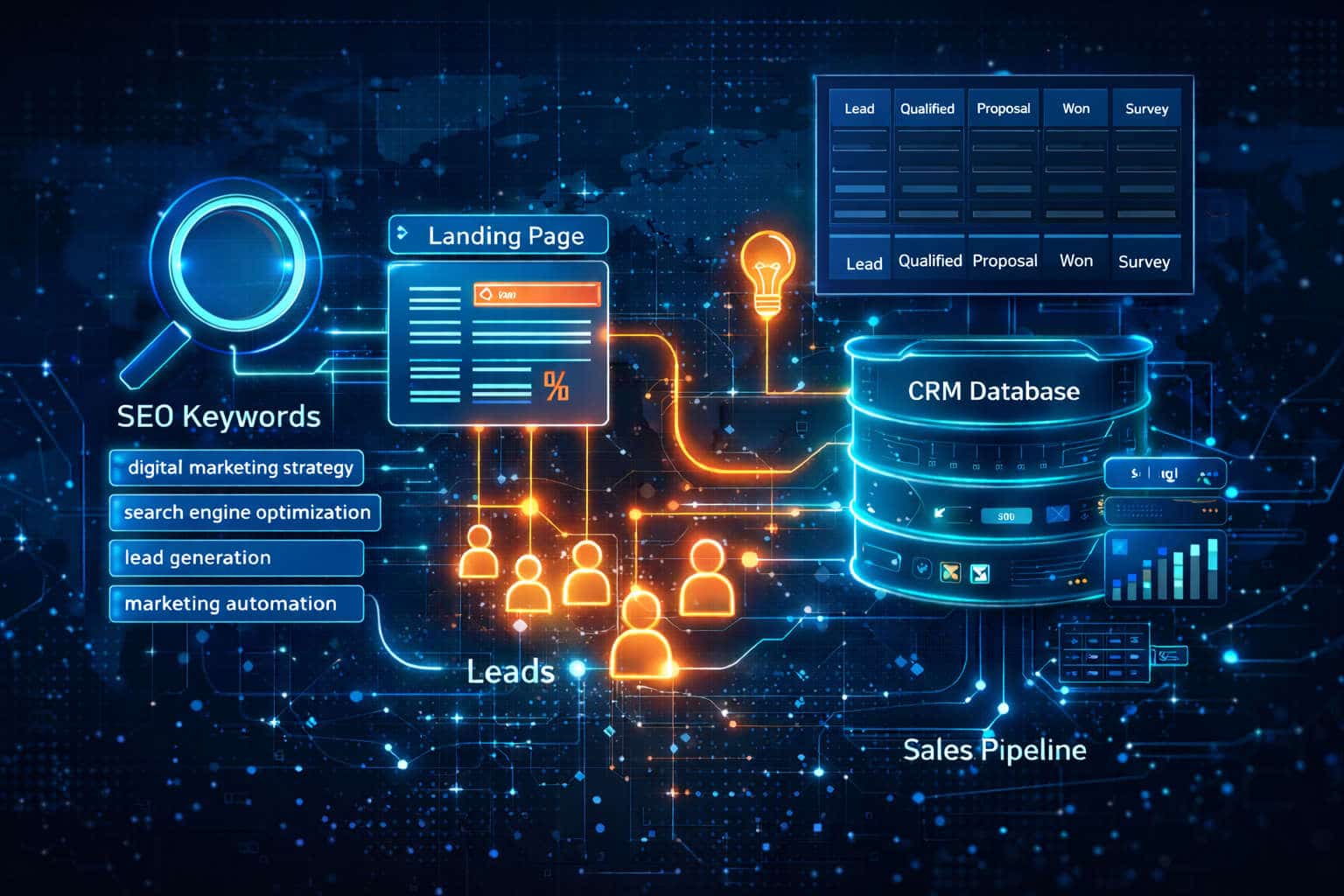

We see it all the time — businesses treat SEO as a standalone activity. They chase rankings and traffic without asking the most important question: are those visits turning into paying customers?
You need to integrate SEO with lead generation and CRM systems so you can turn clicks into clients — not just traffic into charts.
You need to align visibility, capture, and follow‑up, to then attract the right audience, capture their information, and nurture them until they’re ready to buy.
Table of Contents
Why Integrating SEO, Leads, and CRM Matters
SEO drives visibility, but visibility alone does not generate revenue.
When you connect SEO with lead generation and CRM systems, you gain full visibility into the customer journey — from first click to closed deal.
A CRM centralizes customer interactions and streamlines processes so you can track every prospect from initial search to signed contract.
When the marketing and sales teams share data, then you refine keyword targeting, personalize outreach, and focus on the highest‑value opportunities.
Designing Landing Pages and Lead Magnets That Convert
We suggest starting with search intent. If someone searches for solutions related to SEO and CRM integration, they’re looking for strategy — not fluff.
Design landing pages that speak directly to that intent. Then write benefit‑driven headlines, keep copy concise, and use clear calls‑to‑action that guide visitors toward the next step.
Reduce friction by limiting forms to essential fields. Shorter forms increase submission rates and improve overall conversion performance.
Also create valuable lead magnets – guides, webinars, checklists, or strategic resources – that genuinely help prospects move forward.
Think about where to position the content strategically within blog posts and service pages so they align naturally with what visitors are already reading.
Optimizing Forms and User Experience
Over 60% of web traffic comes from mobile devices. That means designing for speed, clarity, and responsiveness from the start.
Use clean layouts, legible typography, and clear error messaging to remove friction.
Try to make sure that in nearly every form, the focus is on reinforcing the value of the offer and reassure visitors that data is handled securely and professionally.
Connecting Your Website to Your CRM
Integrate every landing page and form directly into a CRM so you capture every lead automatically.
Doing this lets you track where each lead originates — which keyword, which blog post, which campaign — and monitor their journey through the pipeline.
With that data, you can score leads, segment them by interest, and automate strategic follow‑up. Centralized systems improve collaboration, eliminate manual errors, and ensure you never lose an opportunity.
Using SEO and CRM Data to Inform Strategy
Analyze CRM data to identify which keywords, pages, and offers generate the most qualified leads — not just the most traffic.
If you see local demand, then you build localized landing pages that address specific search intent.
Use CRM insights — industry, company size, job title — to personalize follow‑ups and recommend the right content at the right time.
Improving Conversion Rates with Data Insights
Combine SEO metrics like rankings and traffic with CRM metrics like submissions and revenue to measure real performance.
Then test headlines, calls‑to‑action, and lead magnet formats. If the bounce rates rise, then you adjust the messaging. If leads stall, you strengthen nurture sequences.
You continuously work to refine the funnel. Incremental improvements compound over time.
Building a Cohesive SEO–CRM Strategy
- Map the customer journey: Outline every stage — awareness, consideration, decision, and retention — and align content with each step.
- Connect your tools: Link your website, analytics, automation platforms, and CRM so data flows seamlessly between systems.
- Align teams: Define what qualifies as a lead, MQL, and SQL, and ensure marketing and sales operate from shared definitions.
- Measure and optimize: Track rankings, traffic, conversions, lead quality, and revenue. Based on that information, then you adjust strategically.
Conclusion
When you integrate SEO, lead generation, and CRM systems, you move beyond vanity metrics and focus on measurable growth.
When you work with Dytatek, we design conversion‑focused landing pages, build valuable lead magnets, help you connect every form to a CRM, and use data to guide decisions.
Whether we’re serving businesses in Central Massachusetts or scaling nationally, this unified system allows us to transform clicks into loyal clients.
Feel free to reach out to us for additional insights on integrating SEO and CRM to improve lead pipelines.